
EV Charging
Electric Car Charger for Home: Planning Guide

Pro Tech Power Corp
· 10 Min Read
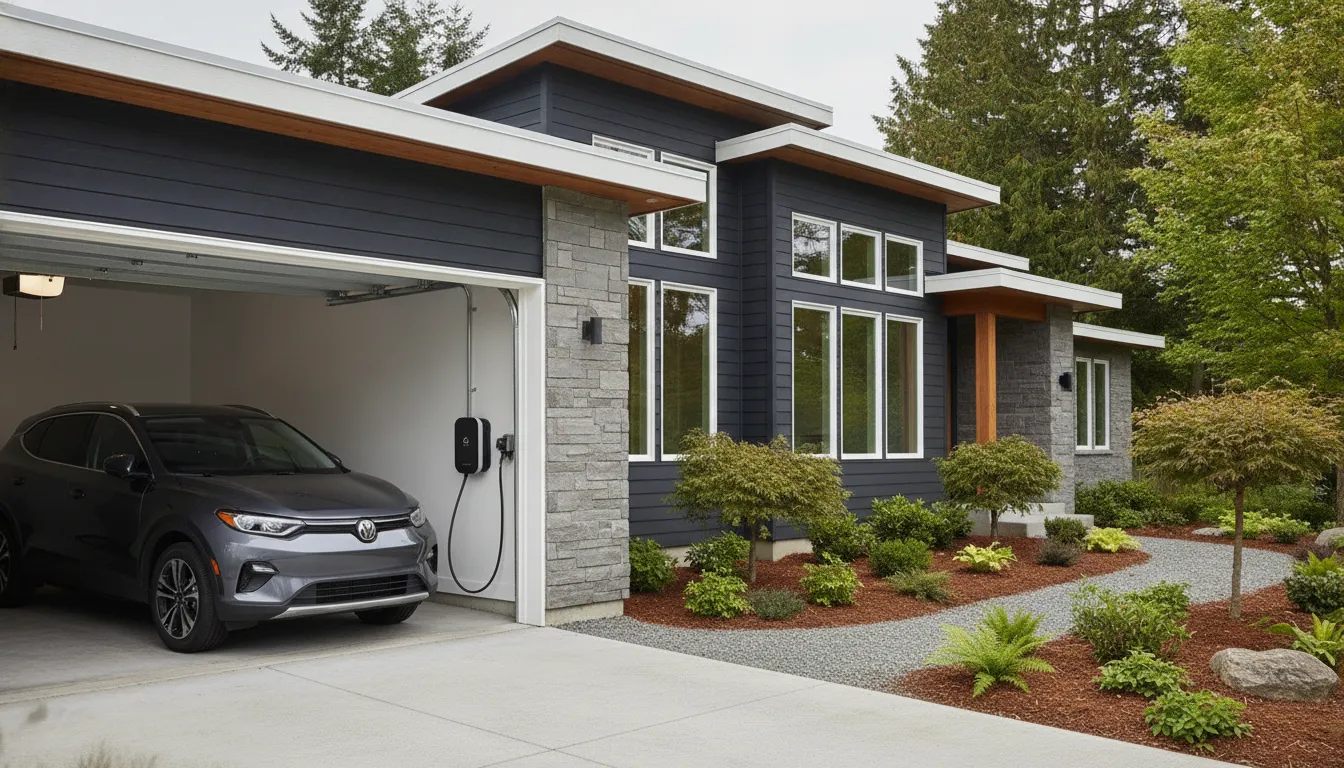
An electric car charger for home is easiest to plan before you pick a brand or a cord length. The two decisions that change the job are where the car will park and whether the existing panel has room for a dedicated charging circuit. Pro Tech Power installs electric car chargers as part of residential electrical work for homes across the Willamette Valley, from Portland and Tigard through Wilsonville, Woodburn, Salem, Albany, and Eugene. A short planning pass now keeps the quote focused on the real parking spot and the real panel.
Start With the Parking Spot, Not the Charger Box
The best location is the place the car already sits overnight. A garage wall next to the driver's door, a carport post, or a short run to a driveway stall all work when the cord can reach the charge port without crossing a walkway. Measure from the likely mount to the charge-port side of the car. Many household chargers use a cord of about 18 to 25 feet, so a mount on the wrong wall can leave the plug short even when the circuit itself is fine.
Indoors is simpler. A garage keeps the equipment out of rain and makes the wiring path easier to protect. Outdoors is still a normal install when the car parks in a driveway or under a carport. The enclosure, the receptacle if one is used, and the mounting height then have to suit a wet location. A detached garage or a parking pad away from the house adds trench or overhead routing, which is a different scope from a charger on the wall beside the panel.
Walk the path before you buy hardware. Note doors, stairs, hose bibs, and anything the cord would have to cross. A charger that forces the cord across the main walk to the front door is a trip hazard every night. If two cars share the stall, decide which one charges and whether the mount can serve both charge-port locations without a second circuit.
Check Whether the House Can Carry the Load
A useful home charger is not a standard 120-volt cord left in a hallway outlet. Faster overnight charging uses a 240-volt circuit, the same class of power as a dryer or range. That circuit should serve the charger and nothing else. NFPA 70, the National Electrical Code, treats this equipment as a continuous load. Overcurrent protection is sized at not less than 125 percent of the charger nameplate. A unit set to 32 amps needs a 40-amp breaker and matching conductors. A unit set to 40 amps needs a 50-amp circuit. Article 625 is the section electricians use for that equipment. Oregon jurisdictions adopt the code with local amendments, so the permit set decides the final details.
Nameplate amps are not the same as "what the marketing page says the car can accept." The car, the charger, and the circuit each have a ceiling. The installation is limited by the lowest of the three. A licensed electrician sets the charger to a value the calculated load can support, then labels that setting so the next person does not turn it up later.
Panel room is the other half of capacity. Open breaker spaces are not spare capacity. The main panel has to carry the charger on top of the range, dryer, heat pump, shop tools, and the rest of the house. If the calculated load is already tight, the honest options are a lower charger setting, an energy management system that pauses charging when other loads are high, or a larger panel. That panel decision has its own guide: when an electrical panel upgrade is needed for an EV charger. Do not guess from the breaker count on the door.
| Home charging setup | What it asks of the house | Planning note |
|---|---|---|
| Portable cord in a standard outlet | Existing 120-volt receptacle on a general circuit | Slow. Fine for a few miles a day, not a plan for daily commuting. |
| 240-volt receptacle, often a NEMA 14-50 | Dedicated circuit, commonly 40 or 50 amps | Lets you unplug a portable unit. The receptacle still needs a calculated load. |
| Hardwired wall charger | Dedicated circuit sized at 125 percent of the nameplate | Fewer plug connections and a cleaner garage wall. Setting must be labeled. |
| Charger plus load management | Controls the charger so it shares capacity with the house | Can avoid a larger panel when the NEC rules for that system are met. |
Hardwired and receptacle installs both show up on residential jobs. A receptacle is useful if you want to take a portable unit on trips. A hardwired unit stays put and removes one set of plug blades that can loosen over years of daily use. Neither choice skips the load calculation. Comparing a dryer-style outlet with a dedicated charger circuit? The 240-volt outlet installation guide covers the outlet. The Level 2 charger installation requirements cover the faster home unit. This page stays on the planning questions that come first.
Questions Before You Buy an Electric Car Charger for Home
Bring these to the estimate. A clear answer on each one lets the electrician price the circuit instead of pricing a guess.
- Where will the car park most nights, and which side is the charge port?
- Is that spot a garage, a carport, or an open driveway?
- How far is the spot from the electrical panel, and is the path finished drywall, open framing, or underground?
- What is the main breaker rating, and are there already large 240-volt loads such as a range, dryer, heat pump, spa, or shop welder?
- Do you want a hardwired charger or a receptacle you can unplug?
- Will a second car need charging later, or is one dedicated circuit enough?
- Are you hoping to use a utility incentive? Electrical prep should be confirmed before paperwork, which is covered in the PGE EV charger rebates and home charging prep guide.
Photos help. A picture of the panel with the door open, a picture of the parking wall, and a picture of the main breaker label give a remote review something real to react to. They do not replace the site visit. Pro Tech Power's residential work includes new construction, remodels, and panel changes. It also includes patio heaters, generator installation, and electric car chargers. The same visit can flag a panel that is already due for attention, even when the charger itself is small.
What the Installer Has to Verify On Site
Planning answers the homeowner's questions. The site visit answers the code questions. Expect the electrician to confirm the main breaker rating, complete a load calculation, choose a conductor and breaker that meet the 125 percent rule, and pick a route that can be protected and supported. If the wiring will be covered, a rough inspection usually happens before drywall. A final inspection happens after the charger is mounted, labeled, and tested.
Cord-and-plug equipment in a garage is commonly fed from a GFCI-protected receptacle. Mounting height matters too: many jurisdictions want the coupling, the whip and plug, at least 18 inches above the finished floor indoors and higher outdoors. Those figures come from the adopted code cycle, not from the charger manual alone. Oregon cities and counties do not all inspect on the same form, so the permit is pulled for the address where the car parks, not for a generic statewide template. The broader compliance picture lives in the EV charging station code requirements article. Use that when the project touches accessibility, commercial stalls, or a multi-unit building. A single-family garage rarely needs that layer.
Skip any plan that shares the dryer circuit with a splitter, backfeeds a panel, or relies on an extension cord as the permanent feed. Article 625 expects an individual branch circuit for supply equipment over 16 amps or 120 volts, unless an energy management system is allowed to supervise more than one unit. A splitter does not do that job. If the panel is full and a new breaker will not land cleanly, read adding circuits to a panel before assuming a tandem breaker is acceptable.
How Pro Tech Power Scopes a Home Charging Visit
Pro Tech Power is a licensed electrical contractor for homes and businesses, not a charger-only shop and not only a generator company. The company has served homeowners, general contractors, and businesses since 2013, holds CCB#198878, and is a COBID certified OSBE #13068. Residential work is part of the same licensed practice as commercial and design-build projects. Electric car charger installation sits with panel upgrades, remodels, patio heaters, and generator installation on the Pro Tech Power residential list.
On a home charging visit, the useful scope is narrow. Confirm the overnight parking spot. Measure the route to the panel. Calculate the load. Then say plainly whether the existing panel can take a dedicated circuit, whether a managed charger is the better fit, or whether the panel should be planned first. The office is at 9386 SW Tigard St., Tigard, OR 97223, and the work is not limited to that city. Homeowners in Beaverton can also start from the Beaverton electrical contractor page. The same planning steps apply along the I-5 corridor.
Price depends on distance, surface, and whether the panel has to be replaced. This guide does not quote dollars. The Level 2 EV charger installation cost in Oregon article separates panel, amperage, and route so a quote is easier to read. If the visit shows the whole panel is aged, the home electrical system upgrade cost page is the right next read, not a charger spec sheet.
Talk with the team about your panel and parking spot
A Simple Order of Operations
Buy the car, or at least know the charge-port side and the onboard charger limit. Pick the overnight stall. Photograph the panel and the wall. Ask for a load calculation before you order a 48-amp unit that the house cannot use. Approve a dedicated circuit sized at 125 percent of the setting you will actually run. Pull the permit, install, inspect, and only then enroll in any incentive that requires proof of a completed, code-compliant install.
That order prevents the common reversal: a charger arrives, the cord is too short, and the panel was never calculated. It also keeps generator plans and charger plans from colliding. Pro Tech Power sells and installs Kohler and Cummins whole-home generators. The company does not repair generators. A new standby generator and a new charger both belong in the load calculation. Tell the estimator about both if either is on the list for the same year.
Frequently Asked Questions
Can I charge an electric car at home without a new charger?
Yes. The cord that comes with many cars plugs into a standard 120-volt outlet and adds only a few miles of range per hour. That can cover a short commute. It is a poor fit for a long daily drive, a shared outlet, or a circuit that already feeds a garage refrigerator or freezer. A dedicated 240-volt circuit is the usual next step when overnight charging has to be reliable.
Does every home need a panel upgrade before a charger?
No. Some panels have both the physical space and the calculated capacity for a modest charger setting. Others are full, recall-listed, or already near the panel limit because of a heat pump and a range. The only reliable check is a load calculation. Use the panel-upgrade guide linked above when the electrician says the panel is the constraint.
Is a NEMA 14-50 outlet the same thing as a home charger?
No. The outlet is just a receptacle on a dedicated circuit. The charger is the equipment that talks to the car. A portable unit can plug into that outlet. A hardwired wall unit does not use it. Both still need a circuit sized for continuous load and a parking spot the cord can reach.
Who should install an electric car charger for home?
A licensed electrical contractor should install it, pull the permit, and meet inspection. Pro Tech Power does this work for houses across the region and can fold it into a remodel or a panel change when those are already planned. DIY cord draping is not a substitute for a dedicated branch circuit.
What should I send when I ask for a quote?
Send the parking location, the charge-port side, the main breaker size, photos of the open panel and the wall, and whether you want a receptacle or a hardwired unit. Mention a second car or a future generator. Those details are what turn a ballpark into a scope.