
Residential
240 Volt Outlet Installation: Homeowner Guide
Pro Tech Power Corp
· 13 Min Read
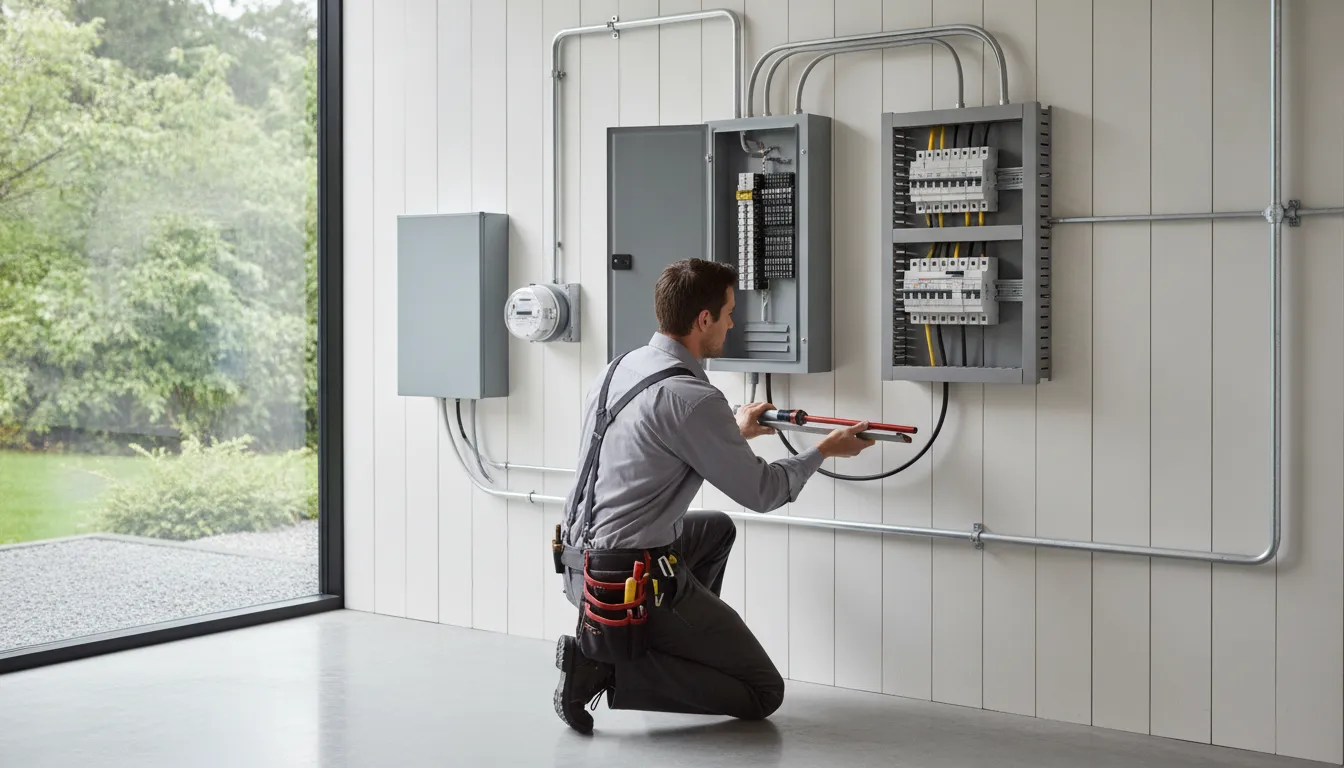
Some household equipment draws more power than a standard receptacle is designed to provide. Electric ranges, clothes dryers, heat pumps, workshop tools, and larger heating equipment may require a dedicated 240-volt circuit based on the manufacturer's specifications.
240 volt outlet installation connects qualifying equipment to the electrical system with the appropriate circuit, protection, wiring, grounding, and receptacle configuration. An electrician must first evaluate the equipment load, existing panel capacity, circuit loading, installation route, and applicable code requirements. An open space in a panel does not automatically mean the system can support a new load. Request an electrical project assessment before making plans.
The right approach depends on what the equipment needs and what the property can safely support. Understanding the voltage requirement is the first step toward choosing the appropriate electrical work.
When does equipment need a 240 volt outlet?
Answer: Equipment usually needs a 240 volt outlet when its manufacturer specifies 240 volts for the load. Compared with a standard 120 volt branch circuit, a 240 volt circuit supplies power in a way that supports many higher-demand appliances and tools. The exact outlet, circuit, and electrical-system requirements depend on the equipment specifications and the property.
Most everyday household devices use 120 volts. Lights, televisions, countertop appliances, and many general-purpose receptacles are common examples. Some equipment draws more power or is designed to operate at a higher voltage. In those cases, using the correct 240 volt connection helps the equipment receive the electrical supply it was designed for. The equipment label, installation manual, or manufacturer documentation should identify the required voltage and amperage.
Common examples in a home
Electric ranges and clothes dryers commonly require 240 volts because their heating elements demand more electrical power than a typical 120 volt receptacle is intended to provide. Heat pumps and larger electric heating equipment may also have 240 volt requirements, although the specifications vary by model and system size.
In a workshop, certain larger saws, welders, compressors, and other stationary tools may be built for 240 volt operation. The voltage requirement is only one part of the decision. The tool may also require a specific amperage, receptacle configuration, or dedicated circuit. A receptacle that looks similar to one used by another appliance is not proof that the connections are interchangeable.
Remodels can bring these questions into focus. Moving a range, replacing a dryer, adding a heat pump, or planning a workshop may require more than changing the wall plate. An electrician may need to consider the existing panel, available capacity, circuit loading, conductor sizing, grounding, the route to the outlet, and applicable code requirements. A panel with an open space is not automatically confirmed to have capacity for a new load.
For homeowners in Tigard, Beaverton, Lake Oswego, Tualatin, Portland Southwest, and surrounding communities, residential and commercial electrical services can support equipment planning across a broader range of property needs. The same principle applies in commercial spaces, where kitchen equipment, specialized tools, and building systems may have their own electrical specifications.
Do not rely on an extension cord, adapter, or guesswork to accommodate equipment that calls for 240 volts. A qualified electrician can review the manufacturer's requirements and the property's existing electrical system. Then explain whether the project calls for a new outlet, a dedicated circuit, or additional electrical work.
How is a 240 volt outlet installation planned?
Answer: A qualified electrician plans a 240 volt outlet installation by matching the equipment requirements to the property's electrical capacity, then designing a safe, code-compliant route and connection. The process is an assessment, not a one-size-fits-all wiring task.
- Review the equipment specifications. The electrician starts with the manufacturer's requirements, including voltage, amperage, phase, connection method, and whether the equipment needs a dedicated circuit. An electric range, clothes dryer, heat pump, workshop tool, or other higher-demand load may each have different requirements.
- Evaluate the panel and electrical supply. The electrical panel distributes power throughout the property. The electrician checks the panel's rating, available capacity, condition, and existing circuits. Open spaces in a panel do not automatically prove that the electrical supply can support another substantial load.
- Account for existing loads. The assessment considers what is already operating on the system and how the proposed equipment may affect overall demand. This helps determine whether the project needs a dedicated circuit, additional circuit protection, conductor changes, or broader panel or supply work.
- Plan protection and conductor sizing. A breaker protects the circuit from excessive current, while conductors carry power to the equipment. Their sizing and compatibility must be selected for the equipment, circuit length, installation conditions, and applicable requirements. These decisions should be made by the electrician, not guessed from a similar-looking outlet.
- Select the receptacle configuration. The outlet must match the equipment connection, voltage, amperage, grounding arrangement, and required configuration. A receptacle that physically fits a plug is not, by itself, evidence that the circuit is suitable.
- Map the physical route. The electrician plans how the circuit will travel from the panel to the outlet. Considering distance, walls, crawl spaces, finished areas, access, protection from damage, and the equipment's final location. Route conditions can affect both the materials and the project scope.
- Review grounding, code, and permits. Grounding provides an important path for fault protection. The electrician also checks applicable national, state, and local electrical code requirements, along with whether permits or inspections apply to the property and project.
- Install, test, and document the work. After the plan is approved, the work is completed by qualified professionals with the power safely controlled. Testing verifies correct operation and protection. Required inspection records, equipment information, and any project documentation should be retained for future maintenance or property records.
Do it the safe way. Do it the right way. Do it every day. A professional assessment can identify the appropriate scope before work begins, whether the result is a receptacle modification, a dedicated circuit, or a larger electrical update.
Can any home add a 240 volt outlet?
Answer: Many homes can support a 240 volt outlet, but no property should be assumed ready based only on an empty space in the electrical panel. A licensed electrician needs to evaluate the electrical supply, existing demand, equipment requirements, circuit path, and property conditions before confirming whether the installation is practical.
An open panel space is only a physical observation. It does not prove that the home's electrical supply has enough capacity for another substantial load. The supply size, the electricity already used by heating, appliances, lighting, and other equipment, and the proposed equipment's voltage and amperage all affect the assessment. In some homes, the existing system may accommodate the new circuit. In others, the electrician may recommend changes to the circuit, panel, or electrical supply before the outlet is added.
What can affect the decision?
The equipment itself is the starting point. An electric range, clothes dryer, heat pump, workshop tool, or larger heating appliance may have different electrical requirements, even when each uses 240 volts. The manufacturer's specifications help determine the appropriate circuit and receptacle configuration. The electrician also considers how the new load will interact with existing circuits, rather than looking at the proposed outlet in isolation.
Routing matters as well. The distance from the panel, the structure of the walls or ceilings, finished areas, crawl spaces. Attic access, exterior exposure, and the condition of existing wiring can all change the installation plan. A remodel may make access easier in one area and more complicated in another. Grounding, circuit protection, receptacle selection, and applicable code or permit requirements also need to be reviewed for the specific property and location.
That is why a 240 volt outlet installation should be treated as an electrical-system assessment, not simply an outlet replacement. If the home needs a dedicated circuit or other electrical work, the right scope becomes clearer after inspection. Pro Tech Power provides residential electrical repairs, remodel wiring, circuit upgrades, and outlet modifications across the Portland-area and Willamette Valley communities.
Questions to ask a licensed electrician
- Does my existing electrical supply have capacity for this equipment and its expected load?
- Does the equipment require a dedicated circuit or a particular receptacle configuration?
- What route and access conditions will affect the installation?
- Will the panel, electrical supply, grounding, or circuit protection need changes?
- Are permits or inspections required for this project in my jurisdiction?
A qualified electrician can answer these questions without guessing from a photograph of the panel. The goal is a properly planned installation that suits the equipment and the home, with safety and code requirements addressed from the beginning.
What if the existing panel needs an upgrade?
Answer: A 240 volt outlet installation may require more than changing the receptacle. An electrician should assess the equipment, existing circuit, panel capacity, electrical supply, and wiring route. And applicable code requirements before deciding whether the project needs a dedicated circuit or broader electrical work.
An open position in a panel does not automatically mean the system can support another high-demand load. The panel is the distribution point for the property, while the incoming power is the electrical supply available to the building. Existing circuits, conductor sizing, breaker requirements, grounding, and the equipment's voltage and amperage all affect the correct scope. The assessment should also consider where the outlet will be installed and how the wiring will reach it.
| Potential scope | When it may apply | What the electrician evaluates |
|---|---|---|
| Receptacle-only work | The existing circuit and wiring are appropriate for the specified equipment and location. | Receptacle configuration, equipment specifications, box, connections, grounding, and required protection. |
| New dedicated circuit | The equipment needs its own circuit rather than sharing capacity with other loads. | Load requirements, breaker and conductor sizing, routing, circuit protection, and panel compatibility. |
| Panel or electrical supply changes | The existing distribution equipment or available electrical supply cannot support the planned load as-is. | Overall demand, panel condition, electrical supply capacity, code requirements, access, and coordination with the utility or authority having jurisdiction. |
These categories are planning possibilities, not a diagnosis. The right answer can change based on the equipment manual. The age and condition of the electrical system, the distance to the installation point, and the property's existing demand. A qualified electrician should make the determination after an on-site or otherwise appropriate assessment, then explain the work required before installation begins.
If the evaluation points toward broader distribution work, review the signs and planning considerations in this guide to an electrical panel upgrade. For high-demand outdoor equipment, the same assessment mindset applies to dedicated circuit requirements. The goal is not to force a particular solution. It is to match the electrical system to the equipment safely and correctly.
Why should a licensed electrician handle the work?
Answer: A licensed electrician should handle 240 volt outlet installation because the work involves higher-demand electrical equipment, live electrical hazards, circuit protection, grounding, code requirements, and testing. A professional can evaluate the property before deciding what the installation requires, rather than assuming an open breaker space or existing receptacle is suitable.
Safety starts with understanding the system as a whole. A 240 volt circuit may require different breaker and conductor arrangements than a standard 120 volt branch circuit. The electrician must account for the equipment's voltage and amperage, the existing panel and electrical supply capacity, circuit loading, the physical route, receptacle configuration, and grounding. These details affect whether the planned outlet is appropriate for an electric range, dryer, heat pump, workshop tool, or other higher-demand equipment.
That evaluation also helps identify conditions that are not obvious from the wall. A panel can have open spaces without having enough usable capacity for a new load. Existing wiring may need changes, the route may present access challenges, or the equipment may require dedicated circuit protection. If the assessment shows that more than an outlet modification is needed, the electrician can explain whether circuit, panel, or electrical supply work should be considered.
Code-aware planning and testing
Licensed journeyman electricians are expected to read blueprints and schematics, maintain current licensing, and work within national, state, and local electrical codes. Where permits or inspections apply, the project can be planned with those requirements in mind. Requirements vary by jurisdiction and project conditions, so they should be confirmed as part of the assessment rather than assumed.
Testing is another important part of the work. After installation, a qualified electrician can check the circuit, connections, grounding, protection, and outlet operation using appropriate professional methods. If equipment does not operate as expected, troubleshooting can focus on the complete circuit and system instead of replacing parts blindly or leaving a potentially unsafe condition unresolved. For practical guidance before arranging a visit, see this overview of licensed electrical repair.
Pro Tech Power is a comprehensive residential and commercial electrical contractor serving the greater Portland area, the Willamette Valley, and surrounding communities. Its work includes repairs, troubleshooting, remodel wiring, circuit upgrades, outlet modifications, specialized commercial equipment installations, and design-build electrical planning. The company holds ESB License No. 13068 and CCB License No. 198878. Learn more about its residential and commercial electrical services. Do it the safe way. Do it the right way. Do it every day.
What should you ask before requesting a quote?
A useful quote starts with useful information. Before contacting an electrician about 240 volt outlet installation, gather the details that help define the equipment, the property conditions, and the work you actually need. This gives the electrician a better starting point and reduces the risk of treating a complex electrical change like a simple receptacle swap.
What equipment will the outlet serve?
Write down the equipment make and model, then locate the manufacturer's specification sheet or installation requirements. The voltage and amperage listed for an electric range, dryer, heat pump, workshop tool, or other higher-demand appliance can affect the circuit, protection, receptacle configuration, and installation plan. A photo of the equipment label can also help, provided the information is clear and complete.
Where and how will the equipment be used?
Share the intended location and purpose. An outlet for a permanently installed appliance may have different planning considerations than one serving workshop equipment. Tell the electrician how far the proposed location is from the electrical panel, whether the area is finished or unfinished. And whether access may be limited by walls, ceilings, cabinets, concrete, or exterior conditions. You do not need to determine the wire route yourself. These details simply help the contractor anticipate the assessment.
What is happening with the existing electrical system?
Report symptoms such as tripping breakers, flickering lights, warm receptacles, unusual odors, or equipment that has stopped operating. Also mention any known panel changes, remodel work, additions, or previous electrical concerns. A panel with open spaces is not automatically proven to have capacity for a new load. The electrician may need to evaluate the electrical supply, existing circuit loading, panel condition, and applicable code requirements before recommending an approach.
Explain whether the project is part of a remodel, new construction, or a standalone equipment installation. Include your desired timing, especially if the equipment delivery or a larger construction schedule is already set. Timing can affect coordination, access, inspections, and the sequence of related work.
Request an electrical project quote with the information you have available. Pro Tech Power scopes projects based on equipment, panel and electrical supply conditions, distance, access, materials, and code requirements. That is why a responsible quote should follow an assessment rather than promise a fixed price from a short description. The same approach supports clear planning for homeowners across the Portland-area and Willamette Valley communities.
Frequently Asked Questions
How much does a 240 volt outlet installation cost?
There is no responsible flat price without reviewing the equipment, panel capacity, circuit requirements, wire route, access, and any code-related work. A professional assessment identifies the actual scope so the quote reflects the property instead of a guess.
Can you install a 240 volt outlet yourself?
It is not a suitable DIY project. The work can involve the panel, circuit protection, conductors, grounding, and energized electrical equipment. The U.S. Occupational Safety and Health Administration identifies live electricity as a serious hazard, so a qualified electrician should plan and perform the installation.
Can I add a 240 volt outlet to my house?
Possibly, but the answer depends on the home's electrical supply, available panel capacity, existing circuit loads, equipment amperage, and the planned route. An open space in a panel does not by itself prove that the system can support the new demand.
How many wires does a 240 volt outlet need?
There is no single answer for every application. The equipment specifications and receptacle configuration determine the required conductors and grounding arrangement. An electrician should select the wiring and protection for the specific equipment rather than relying on a generic diagram or outlet label.
Do I need a permit to install a 240 volt outlet?
Permit requirements depend on the jurisdiction, property, and scope of the work. A professional electrician can identify whether a permit or inspection applies and coordinate the work accordingly. Local requirements may make a permit necessary for this type of installation.
Ready to plan your 240 volt outlet installation?
The right electrical plan depends on your equipment, existing panel, circuit capacity, access, and applicable requirements. A professional assessment can help identify the appropriate installation approach before work begins, whether your project is residential or commercial. Request an electrical project assessment and quote through Pro Tech Power. You can also call 503-780-6207 with questions about your outlet installation or another electrical project.