Generator Fuel Options Oregon: Natural Gas vs Propane vs Diesel
For Portland-area homeowners, choosing a whole-home generator is also a fuel decision. The right option affects how easily the system can run during an outage, whether you need a storage tank, and how much planning installation requires. Kohler and Cummins systems can be configured for more than one fuel type, but the best fit depends on your property and local supply.
Among the generator fuel options Oregon homeowners consider, natural gas is usually the most economical where utility infrastructure is available. Propane provides dependable on-site storage, and diesel delivers the highest energy density for demanding applications.
Natural gas often offers the simplest day-to-day arrangement because underground utility lines provide continuous fuel without a tank on the property. That convenience must be weighed against utility reliability during a major disaster, while local gas availability and pressure still determine whether the installation is practical. Understanding those tradeoffs starts with how natural gas works in the Portland area.
Generator Fuel Options Oregon: Natural Gas for Whole-Home Generators: Availability and Cost in Oregon
For many Portland-area homeowners, natural gas is the most convenient fuel for a whole-home generator. If your property already has natural gas service from a provider such as NW Natural or PGE. The generator can connect to the existing utility infrastructure rather than relying on a tank delivered and stored on-site.
Natural gas is typically less expensive than propane or diesel where utility infrastructure is available, making it an economical choice for standby power. It also arrives through underground utility lines, so a properly connected generator can draw fuel continuously without requiring an on-site storage tank. That can simplify installation planning and eliminate the need to monitor tank levels before an outage. A fuel comparison from the National Generator Authority explains the storage and cost differences among common generator fuels.
Cleaner operation with no routine tank refills
Natural gas burns cleaner than diesel, with lower engine emissions and potentially less particulate buildup in the exhaust system. For a residential installation, that may be an appealing part of the fuel decision alongside cost and convenience. Kohler and Cummins both offer generator models configured for natural gas, giving homeowners established equipment options when the site and electrical load are appropriate.
The reliability question during major disasters
Natural gas is not completely independent of public infrastructure. A major earthquake, severe storm, or other disaster can affect utility service, and a generator connected to the gas network depends on that service remaining available. Propane has an advantage in this specific situation because fuel is stored on the property. The right choice depends on the home’s location, outage risks, available space, and the homeowner’s preference for utility convenience versus on-site fuel storage.
Gas pressure must match the generator
Availability alone does not guarantee a suitable installation. The incoming gas pressure must fall within the generator’s required operating range so the unit can start correctly and maintain performance when electrical loads change. Gas piping must also be sized for the generator and the home’s existing demand. A qualified installer should verify pressure, routing, connection requirements, and local permitting before equipment is selected or installed.
For Portland-area homes with existing natural gas service, this combination of continuous supply, no storage tank, lower typical fuel cost. And broad Kohler and Cummins compatibility often makes natural gas the practical first option among generator fuel options Oregon homeowners are considering.
Propane for Residential Generators: Storage and Runtime in Oregon
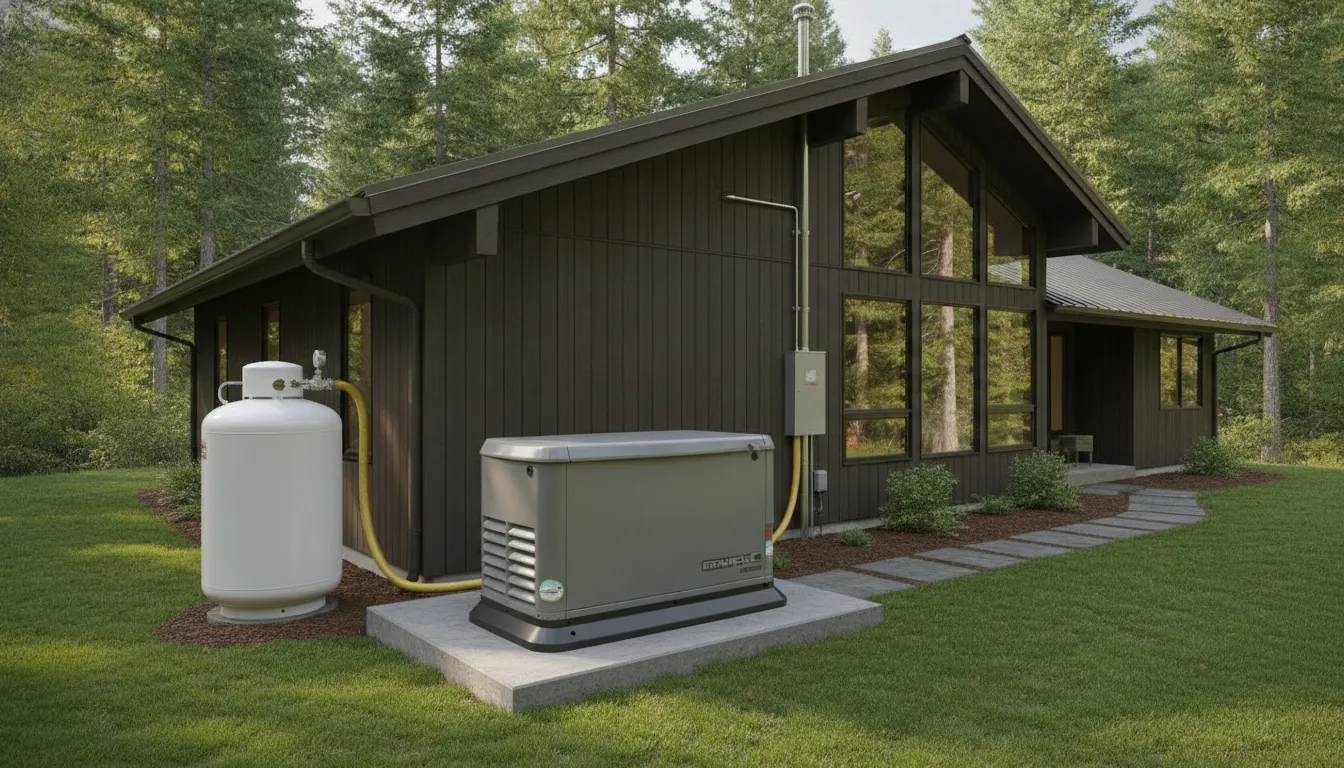
Propane, also called liquefied petroleum gas or LPG, is often the practical choice for an Oregon home without access to a natural gas line. It gives the homeowner an on-site fuel supply and avoids the cost of extending utility piping to a remote or newly built property. Propane also has an indefinite shelf life, so it does not degrade simply because it remains in a properly maintained tank. Propane is considered a reliable backup fuel for residential generators.
Plan tank capacity around real runtime
Propane’s storage advantage comes with a runtime tradeoff. One gallon contains about 73% of the energy in one gallon of gasoline equivalent, according to the U.S. Department of Energy’s Alternative Fuels Data Center. That lower energy density means a propane system may need a larger tank to provide comparable runtime under the same electrical load. Generator size, expected load, and the length of a likely outage should all be considered before selecting tank capacity.
A larger tank is not automatically the right answer. The installation also needs adequate space, safe access for delivery, and placement that works with the home’s property lines and site conditions. An above-ground tank is generally easier to inspect and refill, while an underground tank can preserve the appearance of the property and reduce visible equipment. Both options require proper planning and installation.
Cold-weather sizing matters in Oregon
Propane must vaporize inside the tank before the generator can use it. During colder weather, an undersized tank may not vaporize fuel quickly enough to meet demand. The result can be freezing concerns or pressure drops, particularly when the generator is operating at full load. Portland’s seasonal temperature fluctuations also affect propane vaporization rates, so a fuel system designed only around mild weather may not provide the expected performance during a winter outage.
For that reason, tank sizing should be based on the generator’s full-load fuel consumption and local winter conditions, not just the tank’s nominal gallon capacity. A qualified installer can also evaluate regulator sizing, piping, clearance, and delivery access as part of the whole-home generator installation.
Compare propane with natural gas
Where natural gas is already available, the decision often comes down to the cost of extending gas lines compared with installing and maintaining a propane tank. Propane is especially useful when natural gas is unavailable at the property. A site-specific comparison can show whether the convenience of utility fuel outweighs the flexibility of stored fuel. While accounting for the home’s location, outage expectations, tank placement, and generator load.
Diesel Generators: Power Density and Maintenance Considerations
Diesel remains a practical choice when a generator must deliver high output for long periods. Its main advantage is energy density: one gallon of diesel contains about 113% of the energy in one gallon of gasoline equivalent, according to the U.S. Department of Energy’s Alternative Fuels Data Center. Diesel engines are also generally more energy-efficient than natural gas or propane engines, so they can provide longer runtime from the same volume of fuel.
Why diesel suits high-demand applications
In Oregon, diesel generators are more common in large commercial and industrial settings. These facilities may have substantial electrical loads and enough property for bulk on-site fuel storage. Diesel is particularly well suited to backup applications that require high power output over an extended duration. Such as keeping critical equipment or an entire commercial operation running during a prolonged outage.
That same strength can matter on some rural properties. Where natural gas infrastructure is unavailable, a properly designed diesel system can provide dependable stored-fuel capacity without relying on a utility gas line. For most Portland-area homes, however, diesel is less common than natural gas or propane because the fuel system demands more planning, storage space, and ongoing attention.
Storage and fuel stability require planning
Diesel is not a set-and-forget fuel. Over time, stored diesel can degrade and support microbial growth if the tank and fuel are not managed correctly. Biocide treatment may be needed to help prevent microbial contamination and fuel degradation. Fuel stability should also be monitored, and the fuel may need to be periodically cycled through filters to help protect the engine and delivery system. These requirements are documented in industry guidance on generator fuel type comparisons.
For that reason, diesel belongs in a fuel-planning conversation, not simply a generator-size conversation. A professional installation assessment can compare expected load, outage duration, tank location, access, and the practical demands of stored fuel. Those factors help Oregon property owners decide whether diesel’s power density justifies its added storage and fuel-management responsibilities.
Natural Gas vs Propane vs Diesel: Generator Fuel Comparison
Each fuel creates a different balance of operating cost, storage responsibility, runtime, and resilience. This comparison can help Portland-area homeowners narrow their generator fuel options Oregon homeowners commonly consider before planning a whole-home installation.
| Factor | Natural gas | Propane | Diesel |
|---|---|---|---|
| Fuel cost | Typically lowest where utility infrastructure is available. | Moderate, with tank and delivery costs to consider. | Typically highest for residential standby use. |
| Energy density | Reference baseline for this comparison. | 73% of a gasoline-gallon equivalent (GGE). | 113% of a GGE, the highest of the three. |
| On-site storage | None when supplied through a utility line. | Requires a properly sized propane tank. | Requires a diesel tank and fuel management. |
| Shelf life | Continuous while utility service remains available. | Indefinite when properly stored. | Degrades over time and requires monitoring. |
| Maintenance level | Low fuel-storage burden. | Low fuel-storage burden, with tank sizing important in cold weather. | Higher, including fuel treatments and stability checks. |
| Emissions | Cleanest-burning option of the three. | Clean-burning compared with diesel. | Higher emissions and particulate output. |
| Oregon availability | Common in Portland metro areas with gas utility access. | Available statewide through delivered fuel. | Available statewide, though more common for commercial and industrial systems. |
Natural gas is usually the practical first choice for a Portland-area homeowner whose property has dependable utility access. It costs less in typical conditions and avoids a tank, but a major disaster can affect utility supply. Propane is often the better fit when natural gas is unavailable or stored fuel is a priority. Its indefinite shelf life is valuable, although the tank must be sized for generator demand and Oregon winter conditions. Diesel provides the strongest energy density, but its storage and treatment requirements generally make it more appropriate for larger, extended-duration applications. A professional installer can evaluate fuel availability, expected loads, site constraints, and outage priorities before recommending the right system.
Energy-density figures: U.S. Department of Energy Alternative Fuels Data Center. Fuel storage and operating characteristics: National Generator Authority.
Fuel Options for Kohler and Cummins Generators
For many Portland-area homes, the choice between natural gas and propane is not limited to the fuel itself. It also affects installation planning, operating flexibility, monitoring, and how the generator will support your electrical loads during an outage. Kohler and Cummins offer models that are frequently configured for either natural gas or propane, and many systems use field-convertible fuel arrangements according to generator fuel comparisons.
Kohler: flexibility, monitoring, and residential comfort
Kohler is often a strong fit for homeowners who want fuel flexibility in a carefully planned whole-home backup system. With the appropriate conversion kit adjustments, some Kohler generators can switch between natural gas and propane. That flexibility can provide an additional layer of redundancy when a utility fuel line is interrupted and a properly sized propane supply is available.
Kohler systems also feature digital controllers that support remote monitoring and automated health checks. These tools can help homeowners and installers stay informed about system status without relying on a visual inspection alone. Kohler standby generators are designed with stringent noise requirements in mind, an important consideration when installing backup power near Portland-area residences and neighboring properties.
Cummins: standby output and load management
Cummins generators provide robust standby performance for larger residential and commercial projects where the expected electrical demand may be substantial. Their controllers are designed to prioritize load management, helping keep essential systems powered when the generator cannot or should not carry every connected load at once. A proper load assessment remains important before selecting the equipment, fuel system, or transfer equipment.
Cummins warranty support is contingent on proper installation and documented maintenance. That makes accurate fuel-system design, compliant connections, commissioning, and recordkeeping important parts of the project rather than afterthoughts.
Why professional fuel-system installation matters
Natural gas and propane generators must receive the correct fuel pressure and volume. Kohler installation guidance specifically emphasizes professional installation to confirm gas-piping size and pressure for both fuel types. An installer should evaluate the available gas supply, regulator arrangement, tank or utility connection, generator location, and anticipated loads before equipment is ordered. These details affect starting performance and reliability during load changes.
Pro Tech Power Corp is an authorized dealer and installer for Kohler and Cummins generators. For a closer look at brand differences, read our Kohler vs Cummins whole house generator comparison, then review the whole house generator sizing guidance before planning your installation.
Generator Fuel System Requirements Under Oregon Code
Fuel selection is only one part of a safe standby generator installation. In Oregon, the generator, fuel system, and installation site must be planned together so the equipment can operate safely and remain accessible for inspection and maintenance.
Plan clearances and the equipment pad
Oregon electrical code requires specific clearance distances between standby generators and nearby buildings. These clearances support ventilation and provide safe access around the equipment. The exact layout depends on the generator model, the property, nearby openings, and applicable local requirements. So a proposed location should be reviewed before the pad or fuel lines are installed. Generator installation guidance identifies clearance planning as a core part of compliant placement.
The equipment should sit on a level, reinforced concrete pad designed to prevent settling over time. A stable pad helps keep the generator aligned and reduces stress on connected electrical and fuel components. Site drainage, access for installation, and separation from combustible materials also deserve attention during planning.
Size piping for full-load fuel demand
For natural gas and propane systems, gas piping must be sized for the generator’s fuel consumption at full load. An undersized line can restrict pressure and prevent the engine from starting or carrying its intended load. Kohler whole-home generators require professional installation to verify correct gas-pipe size and pressure for the selected fuel system. That calculation should account for the total connected piping, fittings, regulators, and available supply pressure rather than relying on the existing household line alone.
Permits and inspections are typically required by Portland metro jurisdictions for generator, electrical, and fuel-system work. Requirements can vary by jurisdiction and project conditions, which is why the permitting path should be confirmed before construction begins. Pro Tech Power Corp handles permitting, gas-line sizing, site coordination, and code-compliance details as part of a professional home generator installation.
Frequently Asked Questions
Which fuel option is best for a whole-home generator in Oregon?
Natural gas is often the practical choice when a dependable utility connection is available because it arrives continuously through underground lines. So you do not need an on-site tank. Propane may be better when natural gas is unavailable or when stored fuel is important. Diesel is usually a stronger fit for larger commercial applications that need high output and extended runtime.
What are the main differences between propane and natural gas?
Natural gas generally costs less where utility infrastructure is already present, but its supply can be affected by a major disaster. Propane has an indefinite shelf life and can be stored on site, although its lower energy density means a larger tank may be needed for comparable runtime. The right choice also depends on the cost of extending a gas line versus installing a properly sized propane tank.
Is diesel a practical fuel for residential backup power?
Diesel can work for a residence, but it is more common in larger commercial or industrial installations. Its high energy density supports extended runtime, while stored diesel requires fuel-stability monitoring, periodic filtration, and biocide treatment to limit degradation and microbial growth. Those added responsibilities can make propane or natural gas simpler for many homeowners.
How should a propane tank be sized for Oregon winters?
The tank should be sized around the generator’s full-load fuel consumption, not just its physical fit on the property. An undersized tank can experience freezing or pressure drops during cold weather. Portland’s seasonal temperature changes can also affect propane vaporization, so the fuel system should be designed by a qualified installer.
Can Kohler and Cummins generators use more than one fuel?
Many Kohler and Cummins whole-home models are configured for natural gas or propane, and some offer field-convertible fuel systems. Kohler fuel flexibility may allow switching between those fuels with a minor kit adjustment. Correct gas piping size and pressure are essential, so fuel selection and installation should be confirmed for the specific model.
Schedule Your Whole-Home Generator Installation
The right fuel choice depends on your property, expected runtime, and available infrastructure. Schedule a consultation with Pro Tech Power Corp to discuss a practical whole-home generator installation using Kohler or Cummins options. Call 503-780-6207 to get started.